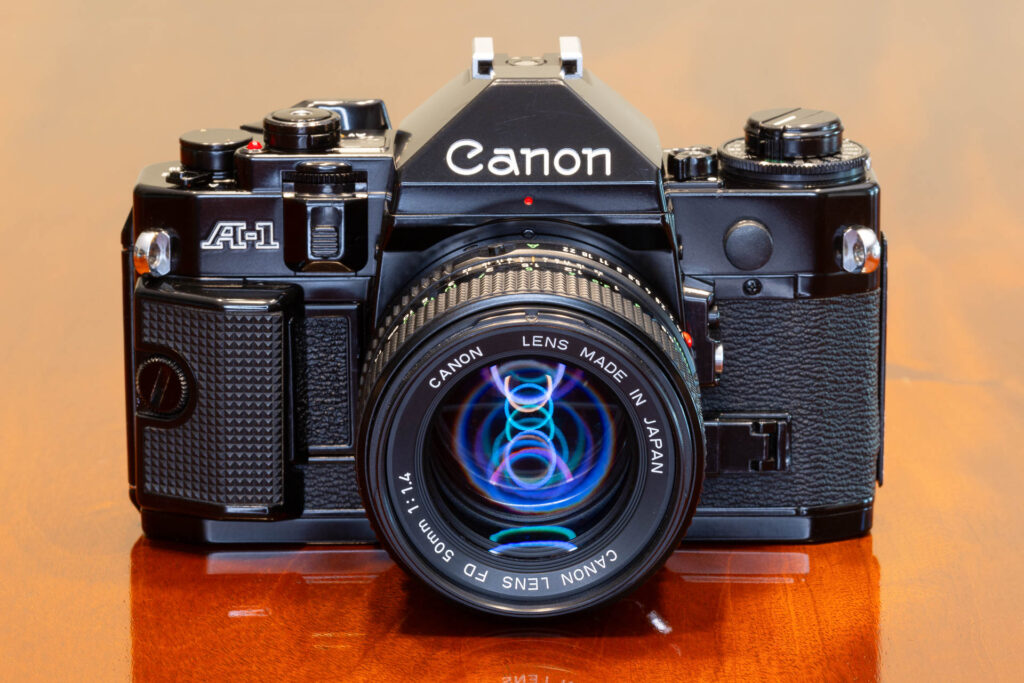
In the mid 1970s, Japanese manufacturer Canon started to develop its A-series of 35mm SLR film cameras, mainly targeting the amateur market. The main characteristics of the A-series cameras were:
- the systematic use of state-of-the-art electronics (integrated circuits/ICs, microprocessor/CPU),
- the introduction of auto-exposure (AE) modes,
- a smaller form factor than the professional SLR cameras of the time (like the Nikon F2),
- the use of the existing Canon FD lens mount (introduced with the Canon F1 in 1971), and
- the increased use of plastic components (like for the top cover).
The first of the A-series cameras was the Canon AE-1, introduced in 1976. It is said to be the first microprocessor-controlled SLR camera and was a huge success. Probably more than 5 million copies were sold until 1984. Like all later A-series cameras, it had an electronically controlled focal-plane shutter with speeds ranging from 2sec down to 1/1000sec (plus B). Besides a full manual mode, it provided a shutter priority mode (Tv; user picks shutter speed, camera selects aperture). The viewfinder contained a needle-based display showing the aperture the camera suggested and an underexposure warning LED.
Two years later, in 1978, Canon introduced the top-tier model of the A-series, the Canon A-1.
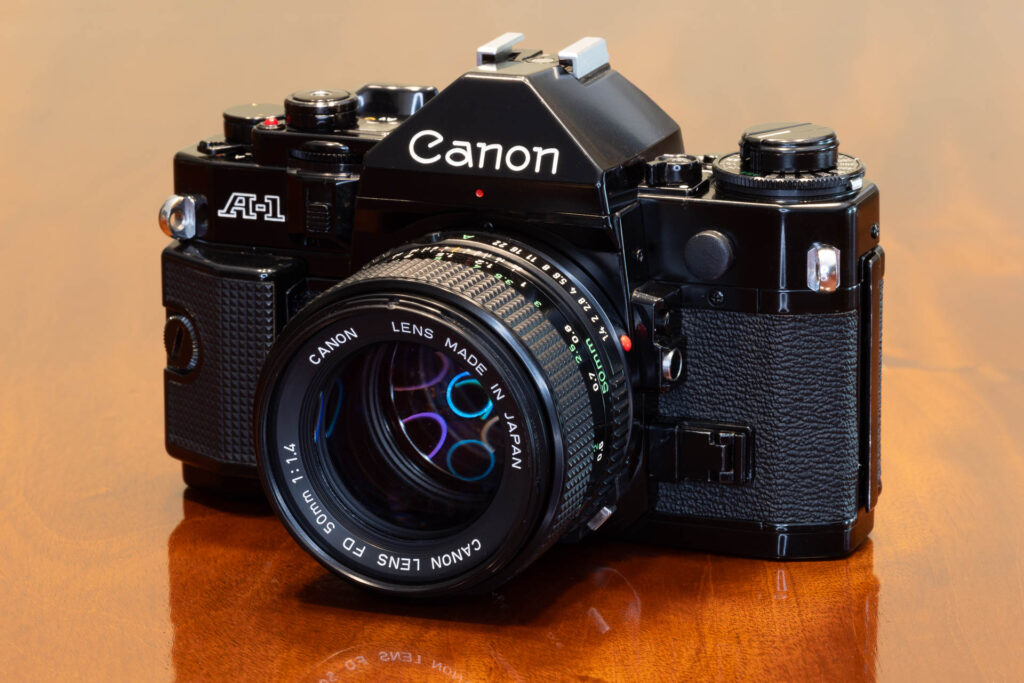
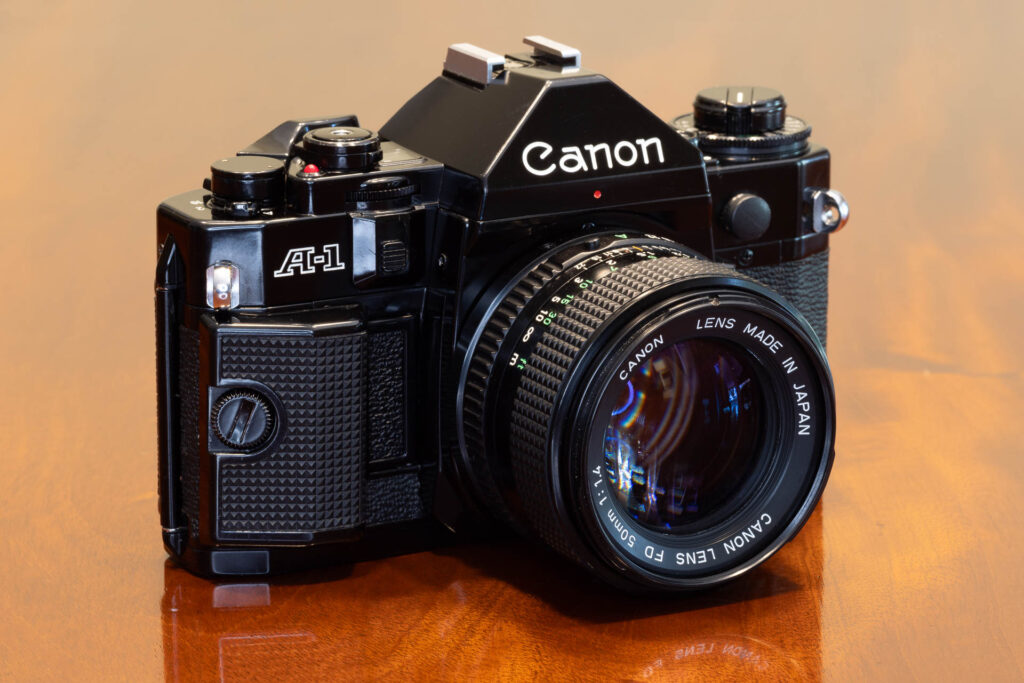
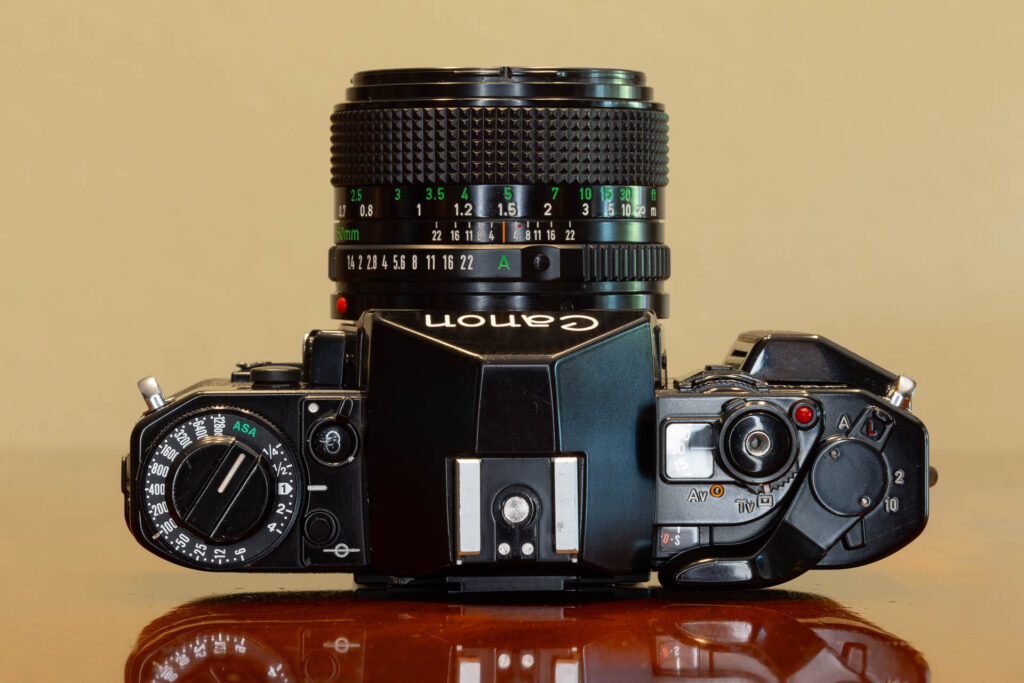
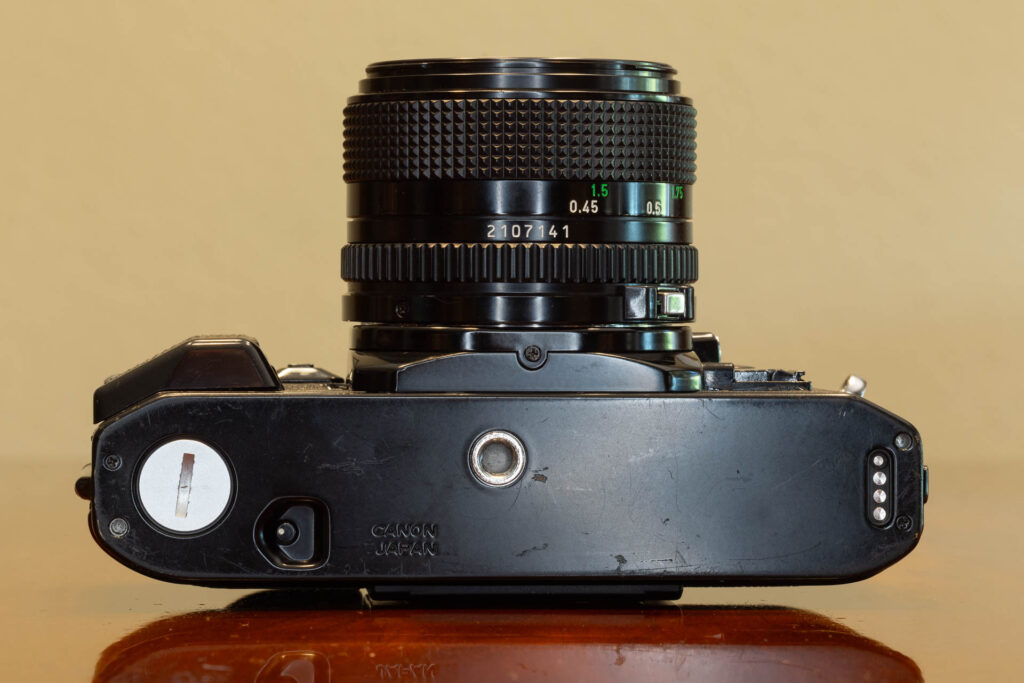
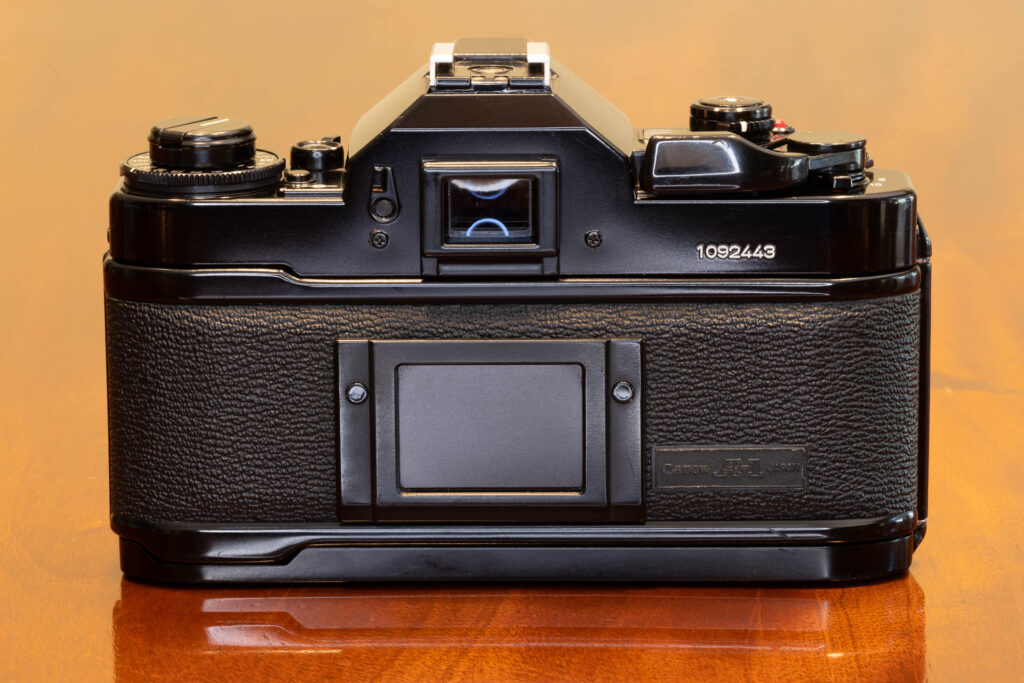
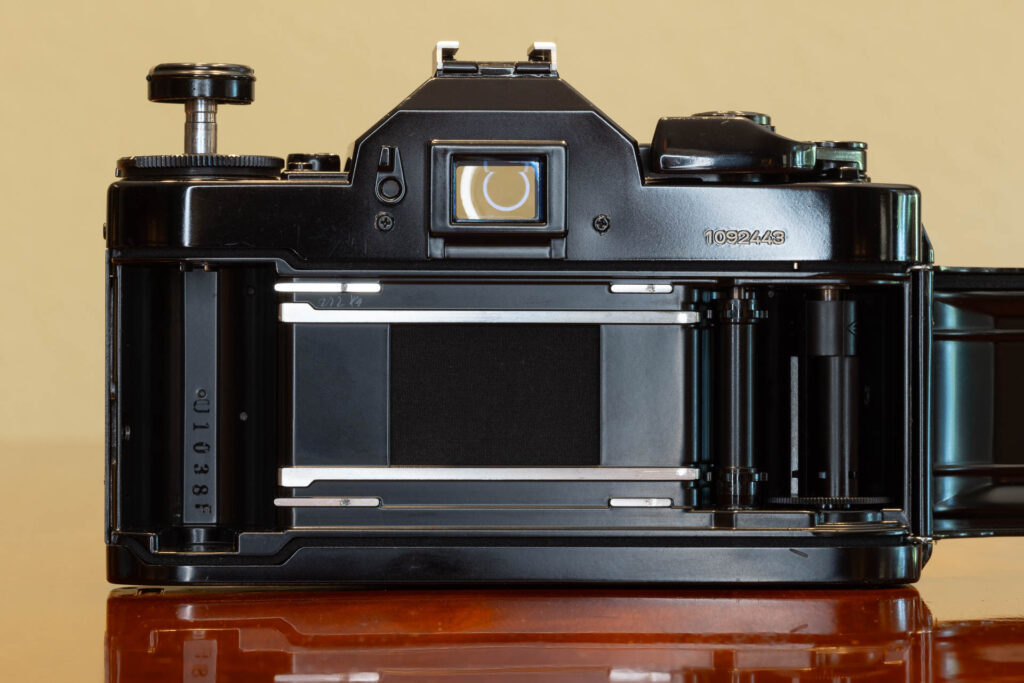
Compared to the AE-1, the Canon A-1 added an aperture priority mode (Av; user picks aperture, camera selects shutter speed) and a full-auto mode (P; camera selects aperture and shutter speed). Also, it introduced a manual +/-2EV exposure compensation and a 7-segment LED display for shutter speed and aperture in the viewfinder. Internally, the transmission of all necessary information, either set by the user (like shutter speed), measured by the camera (like maximum aperture), or calculated by the camera (like EV value), was done in digital form (binary code) using multiple bus systems. In contrast, the corresponding information in the AE-1 was either transferred in analog form or even mechanically (shutter speed, ASA film speed).
Probably more than 2 million copies of the Canon A-1 were sold until 1985. In 1986, it was replaced by the Canon T90 that, in turn, was replaced by the Canon EOS-1 in 1989. The latter camera had a new, incompatible lens mount (Canon EF) and autofocus capabilities.
Within the A-series, the Canon A-1 is the most complex one. It is similar to the AE-1 in its mechanical components, like shutter assembly and mirror mechanism. Therefore, it shares some of the notorious mechanical problems of the AE-1, like stuck shutters, the “Canon cough”, and broken battery doors. However, the Canon A-1 is more advanced in its electronic circuitry and the way information is transferred between its electronic components (binary code via bus systems). This can be quite challenging when diagnosing errors and then fixing them. It may require special tools, like a storage oscilloscope, and special skills, like interpreting digital signal patterns. Although I’m only a hobbyist camera repairer, I will do my best to describe disassembly, error analysis, repair, adjustment, and testing of the Canon A-1 in an ongoing series of posts. See below for the posts already published.
Disassembly
Canon A-1: How to Remove the Top Cover
Canon A-1: How to Remove the Bottom Cover
Canon A-1: How to Remove the Mirror Box
Repair
Canon A-1: How to Fix the Canon Cough/Squeak the Proper Way
Canon A-1: How to Replace the Mirror-Control Unit and/or the Mirror
Canon A-1: The Release Magnet MG2
Reassembly
Canon A-1: How to Install the Mirror Box
Canon A-1: What’s That Mystery Part and Where Does It Belong?
Canon A-1: What Are These Mysterious SAVE Wires?
Testing
Canon A-1: How to Quick Test the Shutter Without a Battery
Canon A-1: Troubleshooting With an Oscilloscope
Tips & Tricks
Canon A-1: How to Open the Back Cover Without Rewind Knob/Shaft
Printed Sources of Information
Essential and trustworthy information on the repair of the Canon A-1 can be found in printed sources, most of them published in the 1970s and 1980s. Usually, they can be found on the Internet in form of PDF scans (for example, at learncamerarepair.com). I recommend the following publications:
- Canon A-1 Repair Guide. ~180 pages
(This is the official repair guide published by the manufacturer. It is quite comprehensive but concentrates more on the electronic circuitry than the mechanical components. For the latter, it refers to the corresponding repair guide of the Canon AE-1. Unfortunately, I haven’t found a copy of the AE-1 repair guide yet.) - Canon A-1. SPT Journal September/October 1981, pp. 6-16
(Condensed advice on how to disassemble the camera, description of ICs, internal switches, signal patterns, and how to diagnose/solve the most common problems.) - Electronic Troubleshooting the Canon A-1. C&C Associates, 1983, 20 pages
(Explains the electronic functionalities, the ICs that are used and how they interact, and the signal patterns. Provides decision-tree-oriented repair advice for the most common electronic problems.) - Canon AE-1. Lawrence C. Lyells, The Camera Craftsman 1977/78 (series of articles), ~70 pages
(Although these articles refer to the Canon AE-1, part of the information on the mechanical components, like the shutter and mirror box, also apply to the Canon A-1. Try to find a good, clean copy; there are also bad scans that are very hard to read.)