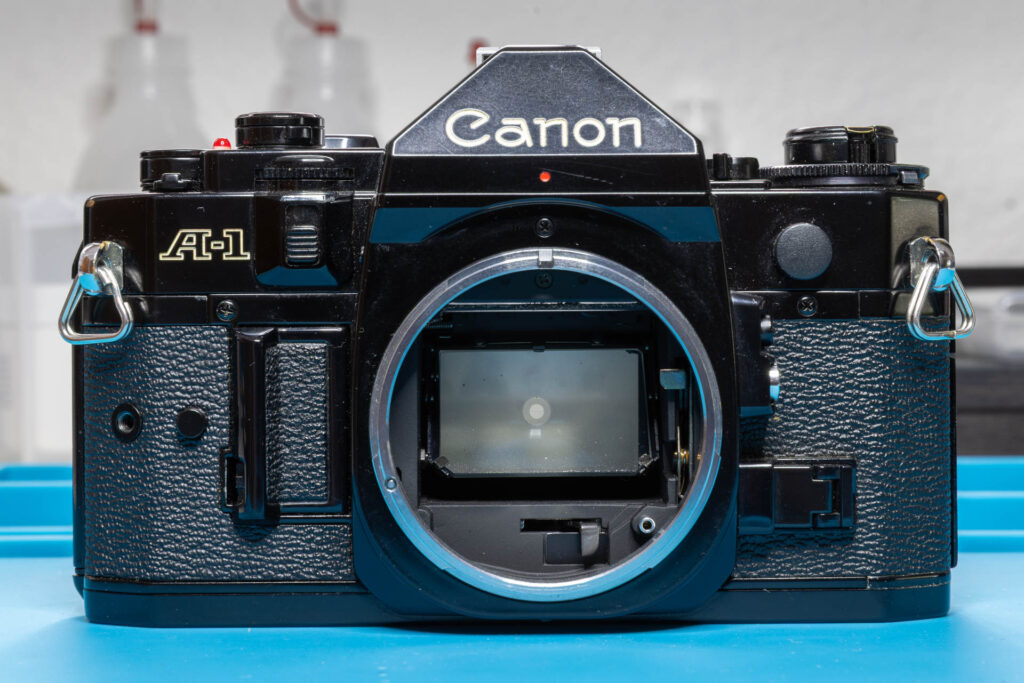
This is one of the camera repairer’s worst nightmares: You disassemble a camera and a part falls out that you didn’t notice before and you don’t know where it belongs. 😧 @#$%&!
This happened to me when I removed the shutter assembly from the camera chassis of a Canon A-1. Afterwards, an inconspicuous part was laying on my work mat. 😖
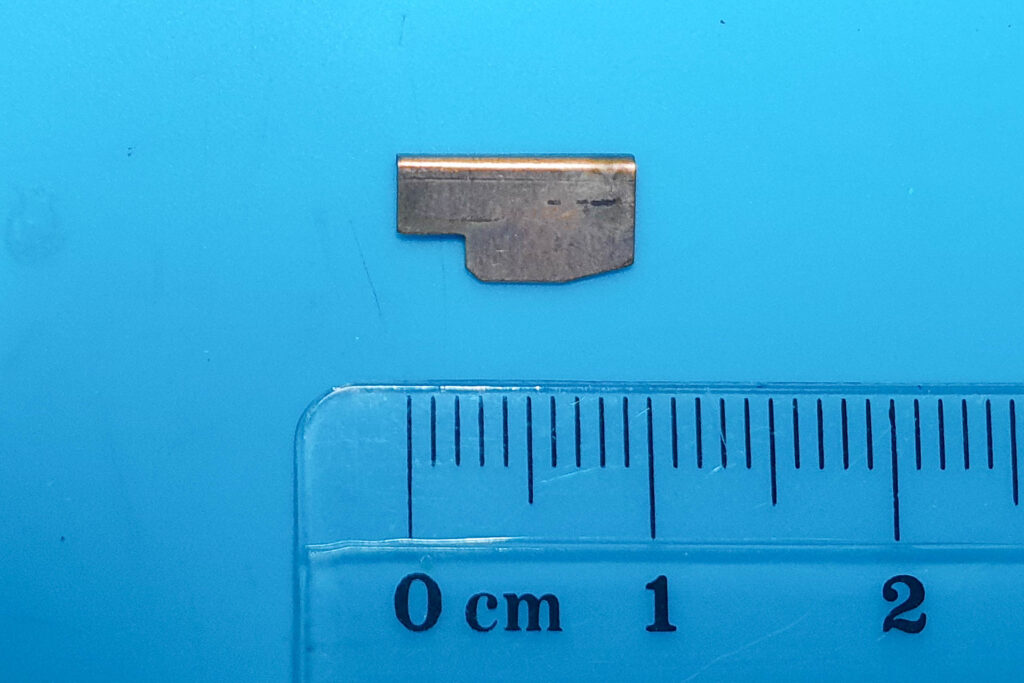
The part appears to be made of copper and has the dimensions 5x10x0.3mm. The long side is bent upwards by about one millimeter. No holes or mounting points whatsoever.
I checked the internet but couldn’t find any mentioning of the part. At first, also the official Canon A-1 service manual was no help either (I only have a copy of poor scan quality). Luckily, I had made a lot of photos during disassembly (highly recommended). On one photo, I could finally see the bent side of the part sticking out between the chassis and the shutter assembly on the backside of the camera, above the film transport sprocket.
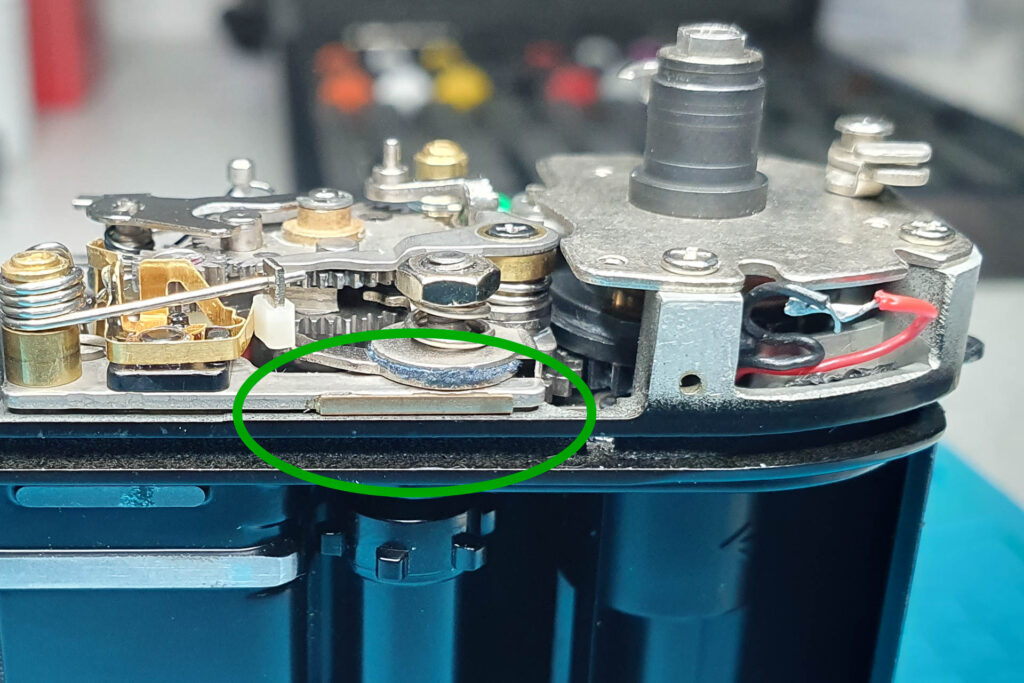
After I had found out the correct position of the part, I also found it in the service manual (page 11 of the parts list). The part is generically called a “washer” and has part number CA1-1148-000. There are five versions of the part available with different thickness, ranging from 0.05mm to 0.30mm. It seems that the part is used to create a very slight angle between the camera chassis and the shutter assembly. Probably to compensate for small manufacturing tolerances. Therefore, naming it “spacer” rather than “washer” would be more appropriate.
Now that we know all that, reinstalling the part is simple: First, put the shutter assembly back into the camera chassis but do not screw it in yet. Then, lift the right side of the shutter assembly (seen from the backside of the camera) slightly. Put the “mystery” part (now we know it’s a spacer) between the camera chassis and the shutter assembly, above the film transport sprocket (see photo above). The part goes in with the bent side upwards and towards you. Finally, screw the shutter assembly in place. Through this, the part will be held in place by the pressure of the screw connection.
That’s all.